
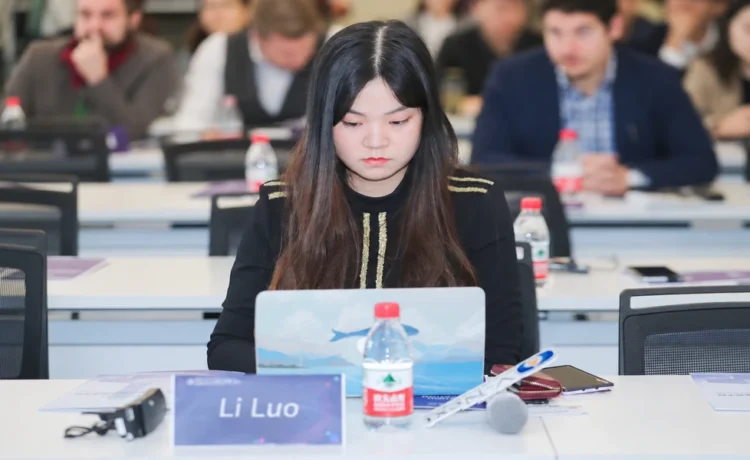
At Vazyme, the US research sales supervisor combined purchasing data with AI-assisted follow-up. She estimates she now reaches 30 to 50 customers on a typical workday, up from 10 to 20.
Li “Vivi” Luo’s sales pipeline spans more than 1,000 laboratories at over 20 universities. When Vazyme promoted her to supervisor in March 2025, deciding which researcher to call became a team decision as well as a personal one. A trial might be ready for a quote. A researcher with a delayed delivery might need help before the team made another sale. Both would appear under the same university name on a list of accounts.
During 2025 and 2026, Luo led Vazyme’s AI Commercial Transformation Initiative. She analyzed purchasing patterns, customer engagement and the stage each opportunity had reached, then used that information to set regional sales priorities. She also developed AI-assisted workflows for prospecting, technical support, quotations and follow-up. The distinction mattered in daily work: sales data could tell her which accounts merited attention that week. Retrieving the relevant product details and drafting the follow-up helped her team act while the scientist was still making a decision.
Luo holds a master’s degree in business analytics from the Hong Kong University of Science and Technology. Before joining Vazyme in 2023, she helped adapt a company-screening model for biopharmaceutical businesses at V-Next in Shenzhen. A shortlist was a useful outcome there. In research sales, she also needed to know when to change its order. A lab that had just completed a trial could move ahead of a stronger prospect that had yet to reply.
As supervisor, Luo reviews sales activity against targets and adjusts the team’s priorities. Consider two labs that have both requested pricing. A repeat buyer may need a pack size and a delivery date. A scientist evaluating a new reagent may need an application specialist before a price means much. Counting two open quotes obscures that difference. Luo built customer-information and product-knowledge tools so that colleagues handling an inquiry could recover the history and decide who should take it next.
A Stanford purchase order illustrates why that distinction matters. Luo says Stanford’s Le Cong Lab uses Q713, a quantitative PCR reagent. But a September 18, 2026, order from that same lab was for P520-03 Phanta Flash master mix, a high-fidelity reagent, at $609 before tax. Looking up the latest order would give a salesperson a precise catalog number and price. Whether either belongs in the next quote depends on which experiment the scientist is planning. The record narrows the question. The representative still has to ask it.
An AI-assisted brief could bring the last order and the relevant product sheet into the same view before the call. The useful question for the scientist would then be whether the lab was replenishing that product or preparing for a different experiment. That distinction determines what goes into the quote. It also determines whether the sales representative can answer immediately or needs a technical colleague.
In her project summary, Luo reports a reduction of more than 60% in administrative workload and more than half in average response time. Sales productivity rose 40% within the initiative, and lead conversion improved by more than 25%, according to the same account. Those figures cover the project. Her estimate of daily customer follow-ups measures a narrower change in her own work: how many people she can get back to in a day.
Her work with Stanford’s Joseph C. Wu Laboratory shows what she chose to teach colleagues. Early purchases came from individual researchers. When the lab began evaluating an automated extraction instrument in November 2025, a successful trial by one enthusiastic user would answer only part of the purchasing question. Several people would share the equipment. Luo involved researchers who routinely ran extractions, the lab manager and technical colleagues, and helped organize a demonstration with the researchers’ own samples.
The researchers could judge whether the instrument worked for their material. The manager could assess how shared use and recurring reagent orders would fit the laboratory’s budget and schedule.
In 2026 the lab installed one extraction instrument and two real-time PCR systems. Luo turned the account into a case for Vazyme’s 2026 Global Leading Customer Sales Case Sharing program and presented it on September 2 to colleagues in North America, Europe, Asia Pacific and Africa. The lesson travelled beyond that particular sale: before arranging a demonstration, find out whose work would change if the trial succeeded.
In Wisconsin, Ziqing Liu, an assistant professor at the Medical College of Wisconsin, had seen the approach from the customer’s side. Luo presented an extraction system to his group online on December 1, 2025. Eight days later, she conducted an on-site trial using the lab’s samples. The group issued a purchase order on December 12. “She understands the science first and then builds the commercial arrangement around it,” Liu wrote in a November 2026 account. He went on to recommend Luo to colleagues at other institutions, including the University of North Carolina at Chapel Hill and Ohio State University. By his account, approximately ten laboratories now use Vazyme products through those introductions.
Vazyme’s November 11 compensation verification letter places Luo first among the company’s North American research sales representatives as of November 10, with year-to-date sales of approximately $470,000. That figure covers her sales work as a whole. The referrals explain something the ranking cannot: why a researcher would put his own name behind an introduction.
In August 2026, a shipment delay left another Wisconsin lab short of Q713. Luo arranged a loan of about five milliliters from Liu’s laboratory and followed up into September on its return and replacement, Liu wrote. For a supervisor reviewing an account, “delivered” might have looked like a reasonable place to stop. Luo recognized that the lending scientist was now the person waiting for her call.