
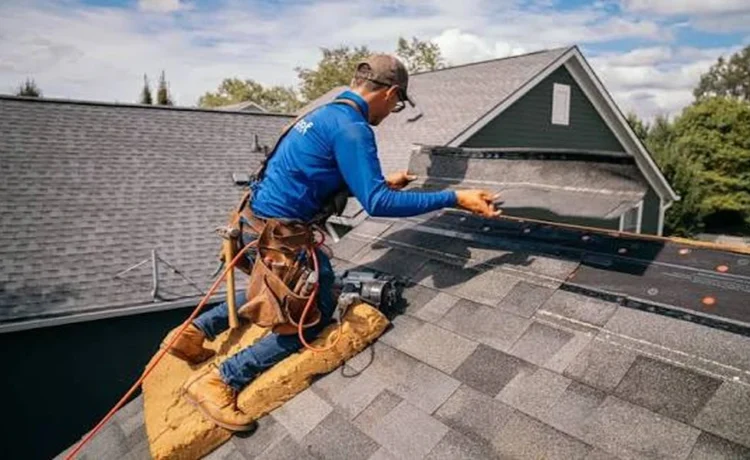
Most people picture an emergency roofer going straight up a ladder in the rain. Good crews rarely start there. A leak shows up on a ceiling, but the water behind it may have entered the roof six or eight feet uphill. From there it can run along a rafter or across the top of the decking and drip wherever gravity finds a low point. Patching the spot directly above the stain is the reason many repaired roofs keep leaking.
So the job follows a fixed order. The crew stops the water, finds where it actually got in, records everything, protects the house overnight, and only then decides between a repair and a replacement. Each stage has its own tools and its own reason not to skip ahead. In Texas, one spring storm line can push wind, hail and sideways rain across Houston, Austin and Dallas in the same week. Keeping to that order also protects the homeowner’s insurance claim.
The phone triage. The first five minutes happen over the phone. The dispatcher asks where the water is showing, whether the ceiling is bulging, whether any light fixtures or outlets are near the wet area, and whether a storm came through. A sagging ceiling gets different instructions than a slow drip. The homeowner is told to put a bucket underneath, poke a small hole at the lowest point so the water drains in a controlled way, and switch off the breaker for that room. These instructions keep a bad night from becoming a collapsed ceiling.
Homeowners around Katy, Houston, Austin and Dallas can hand this whole sequence to Lions Crown Roofing, a crew with more than 20 years in the trade that runs emergency calls alongside full repairs and replacements. The company is certified with GAF and Tamko, so the house tarped on a storm night can later get a manufacturer-backed roof without changing contractors. Its technicians also stay with wind and hail claims from the first report to the finished roof. Anyone who wants a rough number before a ladder goes up can use the free instant estimator on its site, which returns a price in seconds.
Inside first. On arrival, the roofer goes into the attic with a flashlight and a moisture meter, not onto the shingles. The goal is to trace the stain back to its source. That means looking for darkened decking, water lines along rafters, and rusted nail tips. In humid Gulf Coast attics, condensation beading on nail points can look like a leak. Telling the two apart decides whether the fix belongs on the roof or in the ventilation. Once the entry point is found, the roofer measures its distance from something visible from outside, such as a plumbing vent or chimney, so the same spot can be located on the roof surface.
Photographs before anything moves. Before a tarp goes down or a shingle is touched, everything gets photographed: wide shots of each roof slope, closer shots of creased or missing shingles, then the attic and the interior ceiling. Damaged shingles and flashing are set aside instead of thrown away. The Texas Windstorm Insurance Association tells policyholders to make temporary repairs quickly but to wait on permanent work like a roof replacement until an adjuster has inspected. It also notes that reasonable temporary repair costs can be covered when receipts are kept. A careful crew works with that rule in mind from the start.
The temporary dry in. A proper emergency tarp runs up and over the ridge, so water cannot slip under its top edge. It is held down with wood battens screwed through the tarp into the roof, because nails through loose plastic tear out in the first gust. Crews avoid spreading roofing cement over hail-bruised shingles. It can be mistaken for a permanent repair and can hide the very damage the adjuster needs to see. If there is lightning or the roof is too wet to walk safely, the work waits, and the interior gets protected instead.
Drying the house out. Water that is already inside keeps causing damage after the roof is covered. The EPA advises drying wet building materials within 24 to 48 hours to keep mold from taking hold. Soaked fiberglass batts compress and lose most of their insulating value, and wet blown cellulose mats into clumps, so both usually come out rather than being left to dry in place. Fans and a dehumidifier handle the rest.
The split between emergency work and permanent work is where homeowners most often get confused. Here is how a disciplined crew sorts it.
| Task | When it happens | Reason for the timing |
|---|---|---|
| Tarping with screwed battens | The same night | Stops water without changing the evidence |
| Clearing clogged gutters and downspouts | The same visit | Overflowing gutters can push water under the drip edge |
| Removing soaked insulation | Within a day or two | Wet insulation holds moisture against drywall and framing |
| Replacing shingles, decking or flashing | After the adjuster inspects | Permanent work can erase proof of wind or hail |
| Repairing siding where water ran down the wall | After the adjuster inspects | Siding damage often belongs to the same claim |
| Reinstalling attic insulation to full depth | After the roof is sealed | New insulation under an open leak gets ruined again |
The return visit. On a dry day, the crew comes back for a full inspection. Now the repair-or-replace decision gets made based on how many sections are damaged, the roof’s age, whether matching shingles are still made, and whether the decking feels soft underfoot. An older roof baked by years of Texas sun may not take a patch well, because brittle shingles crack when a roofer lifts them to weave in new ones. If a claim is involved, the roofer can meet the adjuster on site and point out the marked damage. Texas law also bars contractors from waiving or rebating a homeowner’s deductible, so any offer to “cover” it is a warning sign.
The closeout. The job is not finished when the last shingle goes down. A thorough crew checks the attic again after the next real rain, confirms the old stain has not grown, reinstalls insulation to its rated depth, and walks the gutters and siding below the repair. Water that came in once tends to leave marks along its path. Checking that whole path, not just the roof surface, is what separates a fixed leak from one that comes back next spring.