
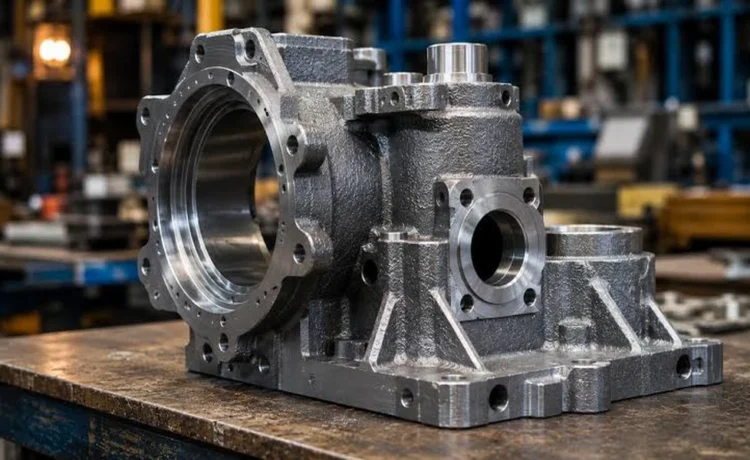
A cracked pump casing on a mine site, a worn crusher jaw, a heavy bracket on a farm machine. Replacements for parts like these often start the same way: as a drawing on one side and a pile of sorted steel scrap on the other. Everything that happens in between takes place inside a steel casting foundry, and each stage leaves its mark on the finished part.
Engineers and buyers rarely see that sequence up close, yet it explains most of what shows up in a quote. A custom steel casting moves through pattern making, molding, melting, pouring, cleaning, heat treatment and inspection in roughly that order, and a delay or shortcut at any one station travels downstream.
Why Is a Casting Pattern Bigger than the Finished Part?
The pattern is a full-size model of the part, made from wood, urethane plastic or aluminum, and it is deliberately oversized. Steel contracts as it cools from liquid to room temperature, so patternmakers scale every dimension up to compensate. For steel, that allowance is commonly around a quarter of an inch per foot, roughly double what gray iron needs.
Size is only one adjustment. Surfaces that will be machined later get extra stock, and walls parallel to the direction the pattern is pulled from the sand get a slight taper so the mold does not tear. Hollow sections, such as the passage through a valve body, are formed by separate sand cores made in their own core boxes. As part of steel casting services, early design review also takes place at this stage, allowing the foundry engineer to decide where the mold will split and where feeding metal will enter.
Green Sand or No-Bake: Which Mold Works for a Steel Part?
Two mold types handle most steel work. Green sand is sand bonded with clay and water, packed around the pattern on fast molding lines, and it suits smaller parts made in larger numbers. No-bake molds use sand mixed with a chemical binder that hardens at room temperature. They are slower to make, but they are rigid and hold their shape well, which is why large, heavy steel parts usually end up in them.
Steel is hard on molds. Its heat can burn sand onto the casting surface, so molds and cores are often given a refractory coating before they are closed. The mold also carries a gating system to deliver metal and risers that act as reservoirs. Steel shrinks noticeably as it freezes, and a well-placed riser stays liquid longer than the section it feeds, topping it up so the shrinkage void ends up in the riser, leaving the part sound.
What Happens Inside a Steel Casting Foundry Before the Pour?
Melting usually takes place in an electric arc furnace or an induction furnace, charged with selected scrap and alloy additions. A sample from the bath goes to a spectrometer, and the chemistry is adjusted until it sits within the grade limits. Some shops send stainless melts through an argon oxygen decarburization vessel to bring carbon down without losing chromium. Small additions such as aluminum are made to remove dissolved oxygen, which would otherwise form gas holes as the metal freezes.
Temperature sets steel apart from most other cast metals. Carbon steel is typically poured at close to 3,000°F, with the exact pouring temperature depending on the grade, section thickness and required casting properties. Many steel shops pour from bottom-pour ladles, drawing metal from beneath the surface so the floating slag stays behind.
Shakeout and Riser Removal: What Does Cleaning a Steel Casting Involve?
Heavy castings may stay in the mold for hours or days to cool evenly. At shakeout, the mold is broken on a vibrating grid, the sand falls away and most of it is reclaimed for future molds. What comes out looks rough: gates, risers and fins of metal are still attached.
On steel, those risers are too tough to knock off with a hammer. Carbon steel is commonly cut with an oxy-fuel torch, while stainless grades resist that method and are cut with air carbon arc or plasma equipment. Shot blasting then strips scale and burnt sand, and grinders take the riser stubs down flush. Any surface defects found at this point can be gouged out and weld repaired under a qualified procedure.
Is Heat Treatment Done Before or After Machining?
In most cases heat treatment comes first. Heating and cooling a steel part can move dimensions slightly and leaves scale on the surface, so finishing a bore before the furnace would waste the effort. The usual exception is a very heavy section that is rough machined beforehand, which helps a quench reach the core more evenly.
The cycle depends on the grade. Plain carbon parts are commonly normalized and often tempered, low alloy parts that need higher strength are quenched and tempered, and austenitic stainless parts are solution annealed. A carbon steel castings manufacturer will typically pour test bars from the same heat, run them through the furnace with the parts and pull them in a tensile tester. Those numbers, along with chemistry and the heat number, appear on the material test report.
Do Steel Casting Services Cover Machining and Final Inspection?
Many steel casting services carry the part beyond the foundry gate. Keeping molding, machining and inspection in one shop means the same datum points are used throughout, which cuts down on parts that measure well in one building and badly in the next. The first piece from a new pattern usually goes through a full dimensional layout before production is released.
Inspection follows the purchase order. Depending on the part, that might include:
- Visual examination against an agreed surface standard for roughness and small indications
- Magnetic particle or liquid penetrant testing to reveal cracks at or just below the surface
- Radiography or ultrasonic testing to look inside thick or pressure-carrying walls
- Hydrostatic testing for valve bodies, pump casings and other parts that hold pressure
Can a Steel Casting Design Change After the Pattern Is Built?
Yes, a custom steel casting can usually be revised after the pattern is built, and small edits such as adding machining stock or moving a boss are routine on wood and urethane patterns. Larger geometry changes may call for new core boxes or a fresh pattern, followed by another round of first-article checks. Any change also ripples into gating, risers and sometimes the heat treatment cycle, so the steel casting foundry needs time to review it before the next pour. Working closely with an experienced casting manufacturer to finalize machined surfaces, material grade and inspection requirements early can save more time than speeding up any single stage later.